Carly’s Triple Negative Breast Cancer Story
Read Carly’s TNBC story, where she shares how she was diagnosed, what treatment was like for her, and how support from her family, friends and online communities helped her through. Carly also talks about living with a BRCA1 gene mutation, navigating life after treatment, and the work she now does to support others affected by TNBC.
About Carly
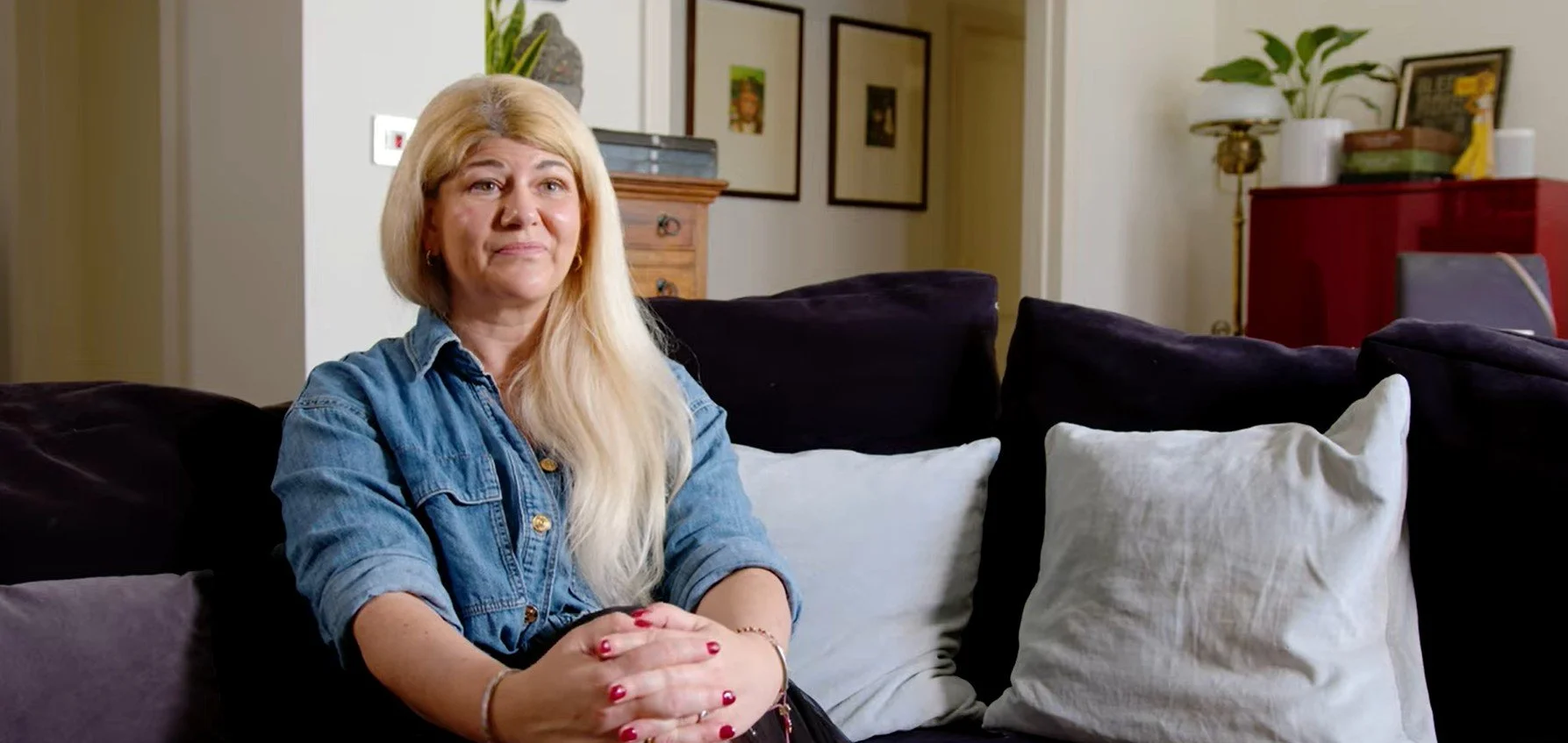
I’m Carly, a wife and a mum of two.
I was 37 when I was diagnosed with triple negative breast cancer. At the time, cancer was already a big part of my family’s story. Even though breast cancer was something I was already very aware of, nothing can really prepare you for hearing that you have cancer yourself.
Noticing painful swelling under my arm
I first noticed swelling under my armpit. It was painful and felt like a golf ball.
At the time, I was with my big sister on a chemotherapy ward, as she was having treatment for ovarian cancer. Her chemo nurse was there and had a look. Because of my family history; with my sister having ovarian cancer and having the BRCA1 gene mutation from my Dad’s side of the family plus my mum and maternal grandmother having passed away from breast cancer, she recommended that I get it checked.
I called my GP and got a same-day appointment. I was then booked in for ultrasounds.
Doctors found what looked to be cysts in my breasts, but I was told it was likely to be okay. Because of that, I assumed I would get a call to reassure me that everything was fine.
Being told it was triple negative breast cancer
I was in a shopping centre, shopping for my little girl’s birthday, when I received the call.
I was told I had breast cancer.
It was really like you imagine. I couldn’t understand what the doctor on the phone was saying.
“When he said, “I’m sorry, it’s cancer,” I went into complete shock.”
Immediately, I thought about my children. They were only four and six.
I was so grateful to be with a friend. I gave her the phone and she wrote notes for me, because I couldn’t take in what the doctor was saying anymore.
At first, I remember thinking, “Well, they’ve told me it’s small, so maybe I won’t need chemo.” But at that point, we didn’t yet know it was triple negative breast cancer.
That evening, I saw my surgeon. He explained that the cancer was triple negative breast cancer. It was small and had been caught early, but because it was an aggressive type of breast cancer, it needed to be treated aggressively.
I found out that I also carried the BRCA1 gene mutation a few months into my treatment. My surgeon explained that I would be looking at radical surgery when I was diagnosed as it was assumed that I probably carried the BRCA1 gene mutation too. This meant a double mastectomy.
It was a lot to process.
Going through treatment
My experience with chemotherapy
Because I had been with my sister for so many of her chemotherapy appointments, I felt oddly confident in a way. Seeing how she had coped with chemo gave me courage that I could too. I was going to be having the same chemo as her. She had bad days, but she would start to get her energy back. She had also been really positive throughout. I think seeing her experience had demystified chemo for me a little. Of course, it still felt strange and scary to be the one sitting in the chair on the chemo ward. I didn’t know how I was going to feel.
Chemo for me was pretty brutal. You get told you’re having 12 weekly chemos and four AC chemos, which are lovingly called the “red devil”. It’s not the greatest thing to be told. But I wanted to have it all. I wanted to give the cancer the best chance of being obliterated.
My sister had had 17 rounds of the same type of weekly chemo I was given, and so I thought I knew what was to come. But on my second week, I had an anaphylactic reaction.
“ I think what that taught me early on was that even if you are receiving the same drugs as someone else, everyone is unique. Everyone has their own path and their own story.”
About a month into chemo, I had a scan that showed the treatment was working. That gave me a boost and the strength to keep going.
I also cold-capped to try to keep my hair. I think it is a great thing to try if you want to retain your hair. By the time I came to the end of chemo, I had lost a lot of hair and was sporting quite a strange look, but I was glad I had tried it.
Chemo showed me how strong we are. Often, we do not give ourselves enough credit for the strength we have to get through really tough things.
Surgery during lockdown
I had six months of chemotherapy alongside immunotherapy, and then it was time for surgery in August, during lockdown.
Because of COVID, visitors were not allowed in hospital. My husband had begged and taken all the precautions ahead of surgery to shield with me, and thankfully he was allowed to visit me one day for half an hour when I was having a really difficult time. I really needed him there.
I was in hospital for a week. After surgery, I went back into treatment, with radiotherapy and then more immunotherapy.
Altogether, my treatment lasted 15 months. It was a very intense 15 months.
Finding support and connection
On the day I was told I had triple negative breast cancer, I told my husband, my family, and my best friends. Some of the most difficult conversations I’ve ever had to have.
I also spoke to my sister throughout, and I was so lucky to have her. We talked every day during treatment. Having someone who understood cancer treatment so closely made a huge difference.
My friends grouped together around me too. I had people beside me when I needed them, even when I did not always know what I needed.
Before I was diagnosed, I had already been doing a lot on Instagram around breast cancer awareness, because it was something I felt very passionate about. I had watched my favourite person, my mum, pass away because of breast cancer, and I knew how important research and new drugs were. When I was diagnosed, I thought, “How can I not share about TNBC?” I was already sharing vulnerable things, so I put a post up in January 2020 to share my triple negative breast cancer diagnosis.
It could not have surprised me more what opened up from that. I found a community that welcomed and supported me, and at that point, I did not know how much I was going to need it.
Because of COVID, there were no in-person support groups or meet-ups. Instagram connected me with so many people. To find others with TNBC, and to be able to post things like, “I’m having this side effect,” or “I’m going through this,” made such a difference.
“We say it is the worst club, but with the best members.”
I have made some of my best friends through the cancer community, and they are part of my everyday life now.
How I coped
I try to always find a positive. There is grief in cancer. There is fear, loss and uncertainty. But I tried to ask myself, “What are the positives in this?” I tried to find the silver linings.
For me, being as present as possible helped. Finding joy in moments, in connections and in getting to be here really worked for me.
But it is also hard not to feel guilty that it has worked for me, because I have lost lots of friends to TNBC. That is a difficult balance to live with.
TNBC, fertility and menopause
When I was diagnosed, there were conversations around fertility and menopause.
I was told that treatment would put me into medical menopause. Before cancer, I had thought maybe I would have a third child if I could, but getting treatment was important to me, and I already had two beautiful children so I didn’t go down the route of egg retrieval. Instead I took Zoladex throughout my treatment to try to protect my ovaries from the treatment.
After I finished treatment, I waited to see if my periods would come back.
Because I carry BRCA1, I also had ovarian screening. I had a big scare around that screening, and because BRCA1 increases my risk of ovarian cancer, and because of my sister’s ovarian cancer, I had to think about what was right for me.
I got to a point where I thought, “I would rather not live in fear of getting ovarian cancer while waiting to see if my period comes back to try for another child”, which was not an easy decision to make but was right for me at the time.
I had my ovaries and fallopian tubes removed just before my 40th birthday.
That caused surgical menopause. I feel strongly that surgical menopause needs to be spoken about more, especially for people who cannot take HRT, like me. I navigate it the best I can. I have had to get used to how my brain works now, because it is different from pre-cancer Carly.
Life after TNBC
I have now celebrated five years since treatment ended, which is a massive milestone with TNBC.
I feel like I have closed a door. That does not mean I’m saying it is never going to come back, but I do not believe mine will now. I am able to go through my days without that fear sitting with me in the same way.
It has not been easy. When you have BRCA and TNBC, you can hear frightening things about recurrence. It is a tough balance between not living in fear, while also knowing it is a possibility.
“But now I am able to have conversations with other people who are where I once was, and hopefully show them that it is possible to get through it and give them some hope.”
Helping others after treatment
After treatment finished, and after sharing my experience online, I felt passionate about doing as much as I could to help the BRCA and TNBC communities.
I now co-host a monthly BRCA meet-up and continue to raise awareness of breast cancer when I can.
A few months after surgery, because of my platform, I was introduced to Dr Saahil Mehta, founder of Bloom43. We became friends and spoke about his work as a plastic surgeon and his work developing a service and device designed to support better healing after breast surgery.
I had just had my double mastectomy and reconstruction using tissue from my tummy. With that kind of surgery, there can be risks and complications, and the work he was doing was focused on trying to reduce some of those risks.
We talked for years. When Bloom43 reached the next stage, I stepped into a role as a patient champion. One part I love is helping bring patient involvement into everything. By the time I got to breast surgery and was talking to surgeons, I felt overwhelmed and disempowered. There had been so much that was out of my control: the diagnosis, chemo and everything that came with treatment. For me, the work with Bloom43 feels like the opposite of that. It is about helping people feel more informed and supported ahead of breast cancer surgery.
A mastectomy is very personal. My breasts had fed my babies. The process of being involved in this work helped me approach my body after surgery in a much more positive way.
My advice for someone newly diagnosed
If you have just been diagnosed, try to find someone who has come through it and can give you hope. I had that from one friend, and that became part of my “why”.
“Speak to people if you can. There are events, charities and communities where you can meet others, hear from people who have been through treatment, and see that you are not alone.”
I did not have access to much of that with my treatment during lockdown, but now I see women arrive at show and tell events ahead of their surgeries looking terrified and leave looking like different people, with some of the fear lifted, having talked to others who have gone through similar surgeries before them.
Try to look for the silver linings, even though I know that can feel impossibly hard at times.
Take lip balm into hospital with you as your lips get so dry after general anaesthetic.
And find charities like The UK Charity for TNBC. We need specific subtype information and personalised support. I wish I had more of that at the start.
Finding support after a TNBC diagnosis
Carly’s story is one person’s experience of triple negative breast cancer, but many people may recognise parts of what she shares: the difficulty of chemotherapy, the life-changing impact of surgery, the decisions that came with living with a BRCA1 gene mutation, and the importance of finding community.
By sharing her story, Carly hopes to show the power of connection. During COVID, when in-person support was limited, Carly found friendship, reassurance and understanding through the online cancer community. Today, she continues to use her experience to support others, raise awareness and help people feel more informed.
If you have been diagnosed with TNBC, or you are supporting someone who has, The UK Charity for TNBC has information and resources to help you feel more informed and less alone. You can also connect with others through the charity’s online forum, explore other TNBC support resources, or join the Patient Advisory Panel to help drive change in TNBC awareness, treatment and care.